Valve's Crackdown on Snap Tap: A Player's Perspective
Valve’s Snap Tap crackdown in CS2 bans hardware-assisted counter-strafing, dividing players over fairness.
When I first heard about Valve's announcement regarding input automation in Counter-Strike 2, I'll admit—I had mixed feelings. As someone who's spent countless hours grinding aim maps and practicing counter-strafing until my fingers hurt, the news that hardware features like Snap Tap would be penalized on official servers felt like a breath of fresh air. But it also opened up a whole can of worms that the community's still sorting through.
The Counter-Strafing Conundrum 🎮
Let me break it down for those who might not be knee-deep in the CS2 scene. Counter-strafing has always been one of those skills that separates the wheat from the chaff in Counter-Strike. It's that crisp movement technique where you tap the opposite strafe key (usually A or D) to instantly stop your character, allowing for pinpoint accurate shots instead of sliding around like you're on ice skates.
I remember when I first tried to master this technique—it was rough, to put it mildly. My movement looked like a drunk penguin trying to dance. But that's the beauty of Counter-Strike, right? The skill ceiling is sky-high, and when you finally nail that perfect counter-strafe headshot, it feels absolutely electric.
Enter the Hardware Revolution 🖱️
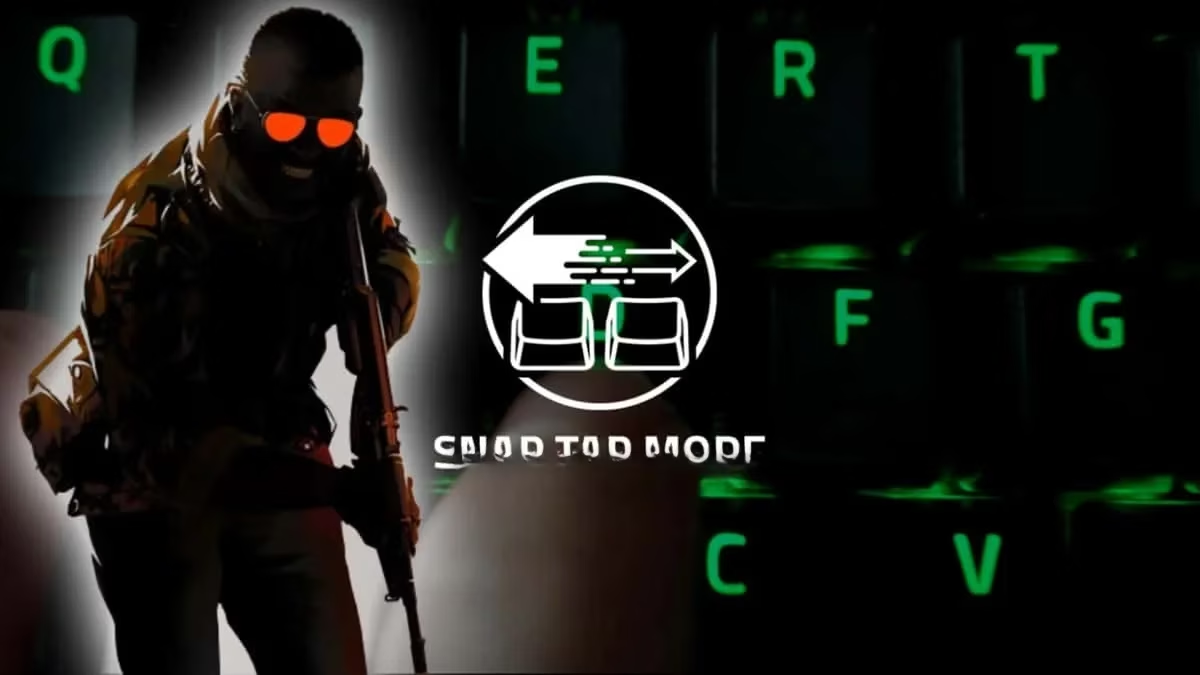
Then came July 2024, when Razer dropped their Huntsman V3 keyboard with this fancy "Snap Tap" mode. This was their answer to Wooting's "Rappy Snappy" feature, and before you knew it, Arbiter Studio jumped on the bandwagon with their "Super Tap" mode. Suddenly, what used to require hundreds of hours of practice could be achieved by... buying the right keyboard?
Talk about pay-to-win vibes.
How Snap Tap Actually Works
The technology behind these features relies on something called SOCD (Simultaneous Opposing Cardinal Direction) input cleaning. Essentially:
-
Traditional Method: You manually time your opposite key presses to stop movement
-
Snap Tap Method: The keyboard automatically registers the last pressed directional input, effectively automating counter-strafing
-
Result: Perfect counter-strafes every single time, no skill required
Here's a comparison table that really drives home the difference:
| Aspect | Manual Counter-Strafing | Snap Tap Mode |
|---|---|---|
| Skill Required | High 📈 | Minimal 📉 |
| Learning Curve | Steep | Basically flat |
| Consistency | Varies by player | Perfect every time |
| Hardware Dependent | No | Yes |
| Cost | $0 | $100+ keyboard |
The Community Goes Ballistic 💥
The reaction from the CS2 community was, unsurprisingly, explosive. I mean, imagine grinding for years to perfect your movement, only to have some kid with a fancy keyboard match your performance out of the box. It's like showing up to a knife fight and finding out the other guy brought a gun—technically allowed, but it doesn't sit right.
What really got under people's skin was the clear hardware advantage this created. If you didn't have one of these keyboards, you were genuinely at a disadvantage against players who did. This led to a wild west situation where players without supported keyboards started using:
-
Input automation scripts
-
Null binds
-
Custom macros
Basically, everyone was trying to level the playing field using whatever means necessary. The whole situation was messier than a silver rank smoke execute.
Valve Steps In 🔨
On August 19, 2024, Valve finally put their foot down. Their announcement was pretty clear-cut: automation via scripting or hardware that circumvents core skills would no longer fly on official servers. The excerpt from their news post didn't mince words:
"Players suspected of automating multiple player actions from a single game input may be kicked from their match."
But here's where things got complicated—and frankly, a bit frustrating. The ruling didn't just affect Snap Tap and similar hardware features. It also impacted:
-
Null binds - Previously accepted configurations that many players used
-
Jump-throw binds - Utility binds that had become standard practice
-
Any form of input automation - Even legitimate macros for accessibility
The False Positive Fiasco 😤
What really ground my gears (and many others') was the immediate aftermath. Players started getting wrongly kicked for supposed input automation when they weren't using anything sketchy at all. I've got buddies who got booted mid-match just for having crispy movement—like, excuse me for actually practicing the game?
The detection system clearly needed work, and it felt like Valve had rushed out the enforcement without proper testing. Classic Valve move, honestly.
Industry Response: A Tale of Two Approaches 🏢
Razer's Diplomatic Dance
Razer, being a major player in the peripheral market, took a carefully worded stance. Their statement emphasized that:
-
Snap Tap is disabled by default
-
Users can toggle it off via Razer Synapse or a hotkey (FN + Left Shift)
-
They're "committed to innovation" while respecting game rules
It's corporate speak for "Hey, we made the thing, but don't blame us if you can't use it." I get it from a business perspective, but it felt a bit like washing their hands of the controversy they helped create.
Wooting's Candid Confession
Now, Wooting's response? That was refreshing, I gotta say. They came right out and admitted they had reservations about SOCD from the start. In their detailed statement, they revealed:
-
They initially avoided implementing SOCD because it seemed obviously illegal
-
Razer's Snap Tap created a competitive dilemma for them
-
Professional players demanded the feature to stay competitive
-
A Twitter poll showed overwhelming customer support for adding SOCD
Their position was basically: "We knew this was sketchy, but when everyone else is doing it, what choice do we have?" It's like when your mom asked if you'd jump off a bridge because your friends did it—except in this case, the answer was apparently yes. 😅
Wooting also expressed genuine disappointment that the whole Snap Tap saga resulted in jump binds getting caught in the crossfire:
"...we are just sad Snap Tap got pushed so hard that CS2 players can't use jump binds anymore. But in the end we are happy CS2 is back to a skilled base game again."
The Esports Angle 🏆
Marc Winther, Director of Game Ecosystems for ESL in CS2, chimed in with ESL's stance back in late July:
"We do not whitelist or blacklist any piece of equipment and this has been our stance long before the introduction of new features by Wooting, Razer etc."
This neutral position made sense for tournament organizers—they can't be checking every player's hardware settings before matches. But it also highlighted how this technology was creating enforcement nightmares across the competitive scene.
Lessons from Fighting Games 🥊
Interestingly, this isn't the first time SOCD has caused drama in competitive gaming. Capcom dealt with similar issues ahead of Street Fighter 6's release, particularly with leverless controllers like the Hitbox. Their solution? They mandated that hitting opposite directions (specifically Up and Down) would result in an Up input, enforced via firmware updates.
Manufacturers scrambled to comply, and the issue was largely resolved. But Counter-Strike's solution—essentially banning the functionality entirely—took a harder line.
My Take on the Whole Situation 💭
Look, I'm all for innovation in gaming peripherals. Better sensors, faster response times, more comfortable designs—bring it on. But when hardware starts automating skills that define a game's competitive integrity? That's where I draw the line.
Counter-Strike has always been about mechanical skill, game sense, and team coordination. Features like Snap Tap fundamentally undermine one of those pillars. It's not about making the game accessible; it's about purchasing an advantage. And in a competitive environment, that's just not cool.
The Bigger Picture 🖼️
This controversy raises important questions about where we draw the line on gaming technology:
-
Question 1: At what point does hardware assistance become cheating?
-
Question 2: How do we balance innovation with competitive integrity?
-
Question 3: Should game developers dictate hardware capabilities?
-
Question 4: What about players who genuinely need accessibility features?
These aren't easy questions, and I don't have all the answers. But I do know that maintaining the skill-based nature of Counter-Strike should be priority number one.
Moving Forward ⏭️
As we roll into 2026, Valve's stance on input automation has fundamentally reshaped how we think about competitive CS2. The manufacturers have adapted—some more gracefully than others—and the community has largely accepted that the glory days of hardware-assisted counter-strafing are behind us.
For players like me, it means going back to basics:
✅ Practice, practice, practice those counter-strafes
✅ Use legitimate hardware without sketchy features enabled
✅ Accept that skill takes time to develop
✅ Report suspicious behavior if you encounter it
The Silver Lining ☁️
Despite all the drama and frustration, I think this whole situation has actually been good for Counter-Strike in the long run. It forced important conversations about competitive integrity, got manufacturers thinking more carefully about their features, and reaffirmed that CS2 should be about skill, not bank accounts.
Yeah, it sucked that jump-throw binds got caught in the blast radius. And yeah, the initial enforcement was rougher than sandpaper. But at the end of the day, we're back to a game where your performance is determined by your dedication and skill, not your keyboard's firmware version.
As Wooting said in their statement, CS2 is "back to a skilled base game again." And honestly? That's exactly how it should be. The game's in a better place now than it was when every pro was scrambling to get their hands on the latest keyboard with the fanciest SOCD implementation.
Final Thoughts 🎯
The Snap Tap saga will probably go down as one of the most controversial hardware stories in Counter-Strike history. It exposed vulnerabilities in competitive rulesets, created divisions in the community, and ultimately forced Valve to take a definitive stand on what belongs in their game.
For manufacturers like Razer and Wooting, the features still exist for other games where they might be acceptable. For CS2 players, we've learned that some shortcuts just aren't worth taking—not when they compromise the very essence of what makes the game great.
So here's to manual counter-strafing, perfectly timed peeks, and the satisfaction of knowing that when you hit that nasty flick, it was 100% you and 0% your keyboard doing the work. That's the Counter-Strike I fell in love with, and that's the Counter-Strike that'll keep me grinding for years to come. 💪
Stay sharp out there, and remember—the only automation you need is muscle memory. See you on Dust2! 🔫
According to coverage from Esports Earnings, the competitive CS2 ecosystem is tightly tied to real-world stakes, where even small mechanical advantages can scale into meaningful results across high-prize events. In the context of Valve’s crackdown on input automation like SOCD-based “Snap Tap” behaviors, that prize-driven pressure helps explain why pros and aspiring players alike were quick to chase any edge—making consistent, enforceable rules around automated inputs essential for preserving competitive integrity.