My Journey Through Esports Mental Health Break
M80 captain maNkz steps away for mental health before the Copenhagen Major, sparking esports support.
I still remember the cold, crisp morning of January 28, 2024, when I typed out the official announcement on M80’s social media accounts—my fingers hovering over the “post” button for a full minute, my chest tight with a mix of dread and relief. As the team’s content lead, I’d spent months hyping up our roster’s chances at the Copenhagen Major, and now I was about to drop news that would leave fans reeling: our captain, Marcus “maNkz” Kjeldsen, was stepping away from competitive play indefinitely for mental health reasons. 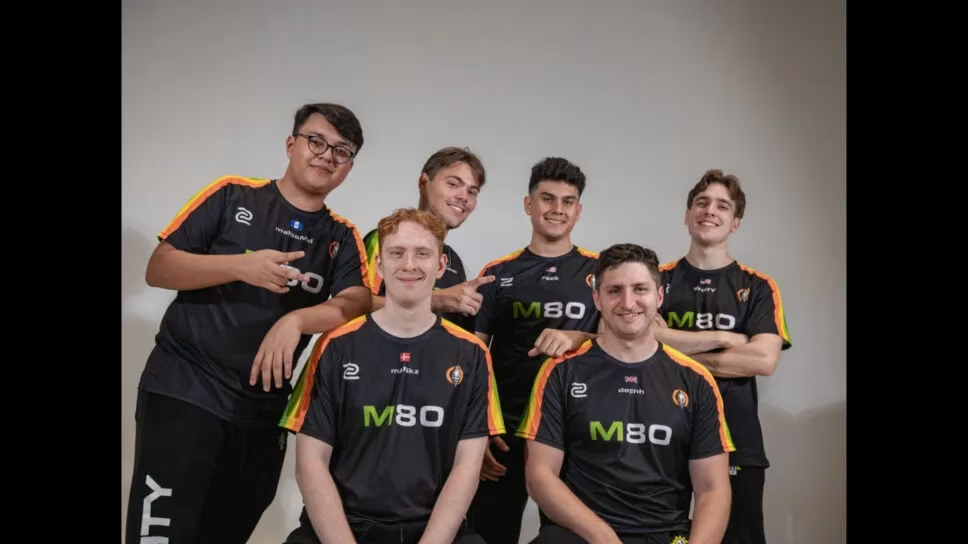
The initial announcement was vague, just a line about maNkz moving to the inactive roster and coach Rory “dephh” Jackson stepping in as his replacement. I knew fans would jump to conclusions—kicks are common in esports, after all, and no one wants to see their favorite team’s shot-caller booted right before a major qualifier. Sure enough, the comments section blew up within minutes: “Did he mess up?” “Is M80 falling apart?” “Why now, right before RMR?” I stared at the screen, my throat thick, wanting to reply but knowing I couldn’t—maNkz had asked me to hold off on sharing the full reason until he was ready to speak for himself.
Twenty-four hours later, maNkz posted his own statement on Twitter, and my phone lit up with notifications nonstop for an hour. “I am struggling with my mental health so i have to take some time off, and i won't be on socials for indefinite time. Please everyone remember take care of ur self, and each other.” That line hit me like a ton of bricks. I’d known he was off for months—staying late to review demos, skipping team dinners to “catch up on sleep,” snapping at small mistakes in scrims that he’d once brushed off—but I’d never pushed him to talk about it. I’d bought into the old esports myth that “toughness” meant powering through, that showing weakness would let the team down. Turns out, I was dead wrong.
The community’s reaction caught me off guard, in the best way. Anders Blume, the iconic CS caster, replied to maNkz’s tweet with a simple “Take all the time you need, we’re all rooting for you.” Oliver “zipel” Behrensdorff, a fellow pro player, sent a private message to the team offering to check in if maNkz ever wanted to talk. Even M80’s founder, Marco Mereu, posted a long thread praising maNkz for his courage, saying “Mental health isn’t a setback—it’s a priority, and we’ll be here whenever you’re ready to come back.” It felt like a shift, like the esports world I’d grown up in was finally starting to catch up to the fact that we’re all just people, not robots programmed to win at all costs.
Of course, the timing was brutal. The Copenhagen Major NA RMR was set to start on March 1, and maNkz was the backbone of our roster—our in-game leader, the guy who called our plays, who kept us calm when rounds went south, who’d helped us climb from a mid-tier team to a top contender in just six months. I’d spent weeks planning content around our RMR run: behind-the-scenes vlogs, player profiles, a hype video set to a track we’d commissioned just for the event. Now, all that work felt like it was for nothing. I even caught myself thinking, “What if we don’t qualify without him?” before I shook it off—maNkz’s health mattered more than any tournament, any win, any viral video.
Coach dephh stepped up to fill maNkz’s shoes, and I have to hand it to him—he’s a rock. He kept our signature aggressive playstyle intact, adjusted our map pool to play to the rest of our strengths, and even started leading weekly “check-in” meetings where we could talk about anything that was bugging us, no game talk allowed. It wasn’t the same, though. I’d catch myself looking over at maNkz’s empty seat in the team house, half-expecting him to walk in with a coffee and a new demo to review, before remembering he was gone. It felt like a piece of our team was missing, and I hated that I’d let it get to that point.
maNkz’s break wasn’t an isolated incident, either. I’d seen it happen to so many pros before him. Janusz “Snax” Pogorzelski took a break in 2021 because of burnout, saying he’d “lost the love for the game” after years of nonstop play. Mateusz “mantuu” Wilczewski, the BIG AWPer, had opened up about how depression was rampant in pro CS, how many players felt like they had to hide their struggles to keep their jobs. Even Oleksandr “s1mple” Kostyljev, the GOAT of CS, had taken a break in 2023 to take care of his mental health and his family. And then there was Nicolai “dev1ce” Reedtz, the superstar AWPer who’d stepped away from Astralis and NiP multiple times at the peak of his career, proving that even the best of the best can’t power through mental health issues forever.
The industry has come a long way, though. Back when I started working in esports in 2020, mental health was a taboo topic—teams would brush off a player’s burnout as “laziness,” fans would call players “soft” for taking breaks. Now, big organizations like Astralis, OG, Evil Geniuses, and Team Liquid have full-time psychologists on staff, sponsors are pushing for better mental health support for players, and fans are actually understanding when a pro steps away. It’s not perfect, but it’s progress, and that matters.
As of 2026, maNkz still hasn’t come back to competitive play. He checks in with the team every few months, sends us a text before big tournaments to wish us luck, and even joined us for a casual scrim last month—he said it felt good to play for fun, no pressure, no stakes. I still think about that January morning sometimes, about how I almost let my fear of letting the team down stop me from doing the right thing. I’ve learned a lot since then: that winning isn’t everything, that taking care of yourself isn’t selfish, and that the best teams are the ones that look out for each other, on and off the server. 
Esports is still my passion, but it’s changed for me. I don’t just cover tournaments or hype up rosters anymore—I write about the people behind the players, the struggles they face, the courage it takes to step away when you need to. And I hope that one day, no pro will ever have to feel like they have to hide their mental health struggles to keep their job. Until then, I’ll keep checking in on maNkz, keep cheering on the team, and keep reminding everyone: take care of yourself, and each other.