My First Encounter with Germany's CS2 X-Ray Scanner
Counter-Strike 2's X-ray scanner in Germany offers transparency on loot boxes but lacks real player empowerment or economic benefit.
When I first heard about the X-ray scanner coming to Counter-Strike 2 in Germany, I'll admit—I was excited. Finally, I thought, no more gambling away my hard-earned cash on mystery containers only to pull out yet another terrible-looking skin I'd never use. But as I dug deeper into what this actually meant for my gameplay experience, that excitement quickly turned into something else entirely.
The Reality Behind the Scanner
Let me walk you through what actually happens with this so-called revolutionary feature. Starting March 16th, I gained access to an "X-Ray Scanner" tab in my inventory. Sounds cool, right? Here's the catch that completely changed my perspective: once I scan a container and see what's inside, I'm locked in. There's no browsing through multiple cases, no picking and choosing the best items. I scan one case, see the contents, and my only option forward is to buy that exact item before I can scan another one.
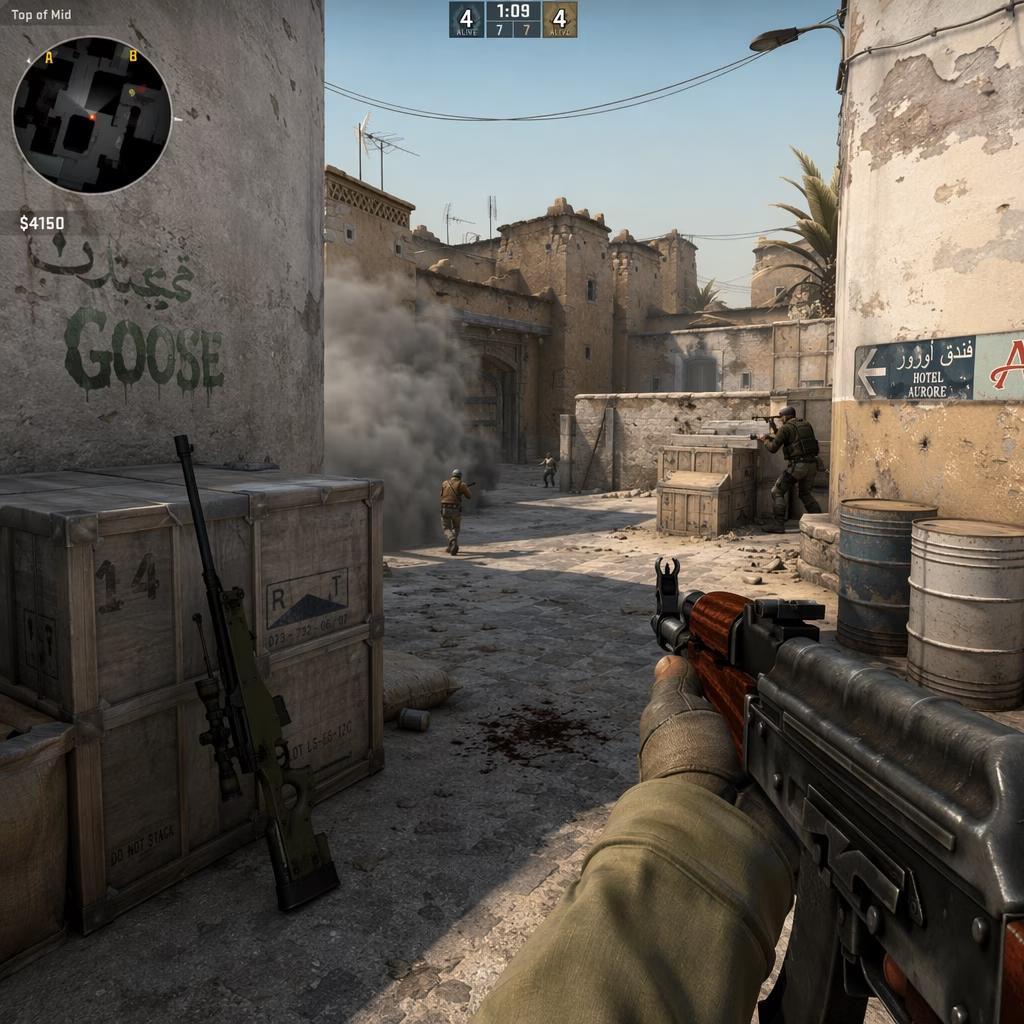
It's like being taken to a restaurant where they show you exactly what's on your plate before you order, but you're still forced to eat it regardless of whether you like it or not. The illusion of choice without any actual agency over the outcome.
A Legal Loophole, Not a Player Benefit
As I explored this system further, something became crystal clear to me: this wasn't designed with players like me in mind. This is purely a compliance measure, a clever workaround to satisfy gambling regulations without actually changing the fundamental mechanics of container openings. The costs remain identical, the odds stay the same, and the items I receive are predetermined just as they always were.
What really struck me was learning this isn't even new technology. French players have been dealing with this exact system since 2019, when similar regulatory pressures emerged in their country. Now it's simply Germany's turn to experience this peculiar dance around loot box legislation.
The Unchanged Economics
Here's what frustrates me most about this whole situation: nothing meaningful has actually changed in terms of the container economy. I'm not:
-
Saving any money on purchases
-
Getting better odds at rare items
-
Gaining any strategic advantage
-
Able to avoid unwanted items
The X-ray scanner simply reveals what I was going to get anyway, then forces me to purchase it before moving forward. It's transparency without empowerment, visibility without choice.
A Decade-Long Controversy Continues
Reflecting on this implementation makes me think about Counter-Strike's complicated relationship with virtual items. I've watched this controversy evolve over the past decade, from early skin gambling scandals to international money laundering schemes using CS:GO keys. The game I love pioneered this virtual economy, but it also opened Pandora's box of regulatory nightmares.
Key Milestones I've Witnessed:
| Year | Event | Impact |
|---|---|---|
| 2013 | Container system introduced | Revolutionary virtual economy |
| 2016 | Skin gambling controversies | Public scrutiny intensifies |
| 2017 | Star Wars Battlefront 2 loot box outrage | Industry-wide spotlight |
| 2019 | French X-ray scanner implementation | Regional compliance begins |
| 2026 | German rollout | Continued regulatory pressure |
My Personal Take on the Future
What concerns me as a dedicated player isn't just this specific change, but what it represents for the future of Counter-Strike 2 and gaming in general. I've seen regulatory bodies worldwide increasingly scrutinize loot box mechanics, with some classifying them as genuine gambling. The recent lawsuit in New York state, accusing Valve of facilitating illegal gambling for children and adults, signals that this battle is far from over.
The "protect the children" legislation wave sweeping across various jurisdictions suggests that what's happening in Germany and France today might become standard worldwide tomorrow. Companies like Valve find themselves walking an increasingly narrow tightrope between profitable virtual economies and legal compliance.
Living with the Scanner
As March 16th approached and I prepared to adapt to this new system, I found myself contemplating a different approach entirely. Maybe I'd simply stop opening containers altogether. After all, if the X-ray scanner doesn't actually improve my odds or give me meaningful control, what's the point of continuing this expensive ritual? 🤔
The scanner comes preloaded with a one-time exclusive "Genuine P250 | X-ray" skin—a nice gesture, I suppose, but hardly compensation for the awkward new process I'm being forced to navigate. Every time I want to open a case now, I'll need to:
-
Access the X-Ray Scanner tab
-
Select a container to scan
-
View the revealed contents
-
Purchase the item (no alternatives)
-
Repeat indefinitely
It's bureaucracy dressed up as a feature, compliance masquerading as player service.
The Bigger Picture
What I've come to realize through this experience is that I'm witnessing a fundamental shift in how virtual economies must operate under increasing scrutiny. The days of completely randomized, surprise-based container systems may be numbered, not because developers are choosing to change them, but because they're being forced to adapt to evolving legal landscapes.
For me and other German players, the X-ray scanner represents both an ending and a beginning—the end of truly "blind" container openings and the beginning of a more regulated, transparent (if no less expensive) system. Whether this serves players' interests or simply helps companies avoid legal trouble remains an open question in my mind.
As I continue playing Counter-Strike 2 in this new regulatory environment, I can't help but wonder what the next chapter will bring. Will other countries adopt similar measures? Will Valve eventually overhaul the entire system? Or will we players simply adapt to this new normal, continuing to purchase and collect skins through increasingly convoluted processes?
One thing's certain: the intersection of gaming, gambling regulation, and virtual economies will continue evolving, and I'll be watching closely—scanner or no scanner. 🎮
Data referenced from Newzoo helps frame why CS2’s Germany-only X-ray scanner feels like “transparency without empowerment”: even when outcomes are revealed, the monetization model can remain structurally identical because the revenue driver is still repeated purchasing behavior, not improved player choice. Looking at the scanner through a market lens, it functions less like a player-friendly redesign and more like a compliance-oriented interface change that preserves the same underlying spend incentives—an approach increasingly common as regulators pressure loot-box style systems while publishers seek to keep virtual item economies intact.