G2 Esports' AI Agent: How Sami is Redefining Fan Engagement
G2 Esports AI agent Sami, powered by Theta Network, revolutionizes fan engagement with 24/7 personalized interactions.
I've been following esports for years, and honestly, I never thought I'd see the day when a digital mascot would become smarter than half the community managers out there. But here we are in 2026, and G2 Esports just dropped something that's making me rethink everything about how teams interact with their fans.
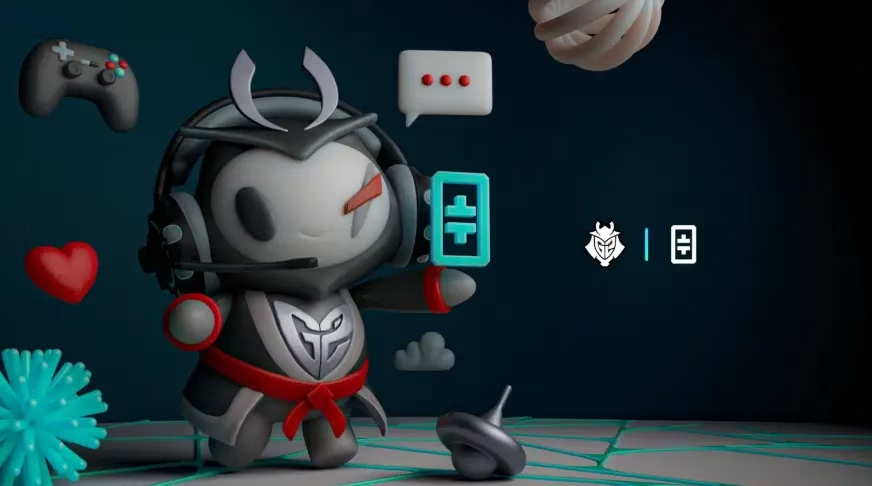
While most teams are still fighting it out on the servers for prize money, G2 decided to take a completely different approach. They've partnered with Theta Network to transform their legendary mascot into a fully functional AI agent named Sami. This isn't just some chatbot that spits out canned responses – I'm talking about a sophisticated digital entity that's deeply integrated into G2's social networks, website, and Discord server.
What Makes Sami Different?
Let me break down what's actually impressive here. Sami knows everything about G2 – current lineups, match schedules, tournament standings across all their competitive titles. When I first heard about this, I was skeptical. We've all dealt with those frustrating automated support systems that can barely understand basic questions. But Mitch Liu from Theta Labs explained something that changed my perspective: fans demand information 24/7, and neural agents can maintain that level of engagement across all channels while preserving G2's unique voice and style.
The Tech Behind the Magic
Here's where it gets really interesting. Sami isn't just running on some standard cloud server. The whole system is deployed on Theta EdgeCloud, which is tightly integrated with the Theta Network blockchain. They've essentially created a decentralized powerhouse that can handle massive amounts of data processing in real-time.
The technical setup is genuinely mind-blowing. Theta EdgeCloud combines tens of thousands of private edge nodes with the capacity of giants like Google Cloud, totaling over 80 petaflops of processing power. That's an absolutely insane amount of computational muscle.
Here's how the load distribution works:
-
Complex queries → Elite NVIDIA A100 or H100 GPUs
-
Standard fan questions → Local RTX 3090/4090 graphics cards
-
Real-time analytics → Hybrid processing across the network
This strategic approach means G2 can scale during those intense tournament finals without worrying about servers crashing. Low latency is guaranteed worldwide, which is crucial when you've got millions of fans across different time zones all demanding instant answers.
The Blockchain Connection 🔗
Now, I know what you're thinking – "Why does an AI chatbot need blockchain?" Fair question. Theta Network isn't trying to cram the entire AI model into a smart contract (that would be ridiculously slow). Instead, the blockchain acts as a global coordinator for the distributed GPU network.
Nodes get rewarded for providing their computing power, and cryptography ensures the reliability of the entire system. This is what they call DeFAI – Decentralized AI. The calculations spread across the network, which reduces operational costs by 3-5 times compared to traditional cloud services. Plus, there's no single point of failure. If one server crashes, Sami doesn't even blink.
Training a Digital Expert
What really impressed me is how they trained Sami to capture G2's personality. This isn't just a generic AI that's been fed some basic facts. They've poured everything into this system:
-
Club meme culture and lore
-
Exact event timings across League of Legends and VALORANT
-
Latest news and blog updates
-
That signature cocky tone that G2 is famous for
The technical cycle is remarkably efficient:
-
Data Collection → Strict filtering to eliminate garbage
-
Dataset Formation → Creating unique training materials
-
GPU Cluster Training → Running on Theta's distributed network
-
Iterative Updates → Instant database rebuilding when rosters change
Did G2 switch their CS2 captain? The model instantly reassembles its knowledge base so it doesn't give outdated information. That's the kind of responsiveness that makes this feel truly next-generation.
Under the Hood: How Requests Work ⚙️
From a user perspective, it looks simple – just another chat window. But when you send a message to Discord, there's a complex operation happening behind the scenes:
| Step | Process |
|---|---|
| 1 | Frontend receives your message |
| 2 | Backend layer processes the request |
| 3 | Query sent to Theta EdgeCloud |
| 4 | Smart routing finds nearest available node |
| 5 | AI generates response with live data |
| 6 | Answer delivered almost instantly |
Even with 50,000 people flooding the chat simultaneously, responses come back in milliseconds. The agent can pull fresh tournament telemetry via API on the fly, mixing static knowledge with live statistics directly from active matches. That's pretty wild.
The Bigger Picture 🎯
G2 gets complete independence from centralized providers. Heavy computational tasks go to top-tier servers, while massive fan interactions get handled by cheaper edge nodes. It's the perfect balance of power and efficiency.
For fans like us, we essentially have a personal insider who doesn't just Google information – it analyzes team performance and provides in-depth analytics. The decentralized architecture makes Sami not only intelligent but also incredibly cost-effective to maintain long-term.
This raises a fascinating question: if AI is already this good at analyzing esports data, how soon will it start predicting match outcomes more accurately than the best bookmakers? I genuinely think we're approaching a new era where information becomes the ultimate competitive weapon.
G2's Momentum Continues
Beyond the AI innovation, G2 isn't slowing down in traditional esports business either. Since early 2026, they've:
-
✅ Established collaboration with NORD Esports for their League of Legends team
-
✅ Signed partnership with French gambling giant Winamax
-
✅ Became most viewed Rainbow Six Siege team on Liquipedia by end of 2025
-
✅ Dominated regional VCT Americas events last year
Yes, they took a tough loss at the Six Invitational 2026 in Paris, falling 1-2 to Team Secret in the playoffs. But their influence on the competitive scene remains massive. They currently maintain top-tier lineups across LoL, CS2, Valorant, and Call of Duty – that's a seriously powerful structure.
Why This Matters for Esports 💡
It makes complete sense that media giants like G2 would be first to implement this technology. Keeping millions of fans engaged across different time zones is a challenge that only advanced AI agents can truly handle at scale.
Theta Network is already expanding rapidly – they've digitized assistants for Cloud9, NRG, Sentinels, and 100 Thieves. The era of traditional live support managers in esports might genuinely be fading away.
I believe this is just the beginning of how technology will transform our experience with esports news and community interaction over the next few years. The future isn't coming – it's already here, answering questions in your Discord server right now.
Honestly? I'm curious to see which organization decides to "revive" their mascot next. This technology has proven itself, and the competitive advantage it provides is undeniable. If you're running an esports organization and you're not exploring AI agents yet, you're probably already behind. 🚀